Showing posts with label Lives in Letters. Show all posts

Monday, June 25, 2007

Lives in Letters: Postcards from Chocolatetown

I found a quick series of postcards from Hershey Pennsylvania in my travels today, and being inclined towards chocolate, I thought these would be fun to talk about.

Postcards

Recreation Spot
Rustic Bridge
Cow Herd

Hershey Chocolate Co.
Hershey, Pa.


Chi & Carbondale R.P.O.
October - November, 1909


Addressed to:
Mrs. D. A-
Streator, Ill.


Messages:

October, 1909
Dear Mother + Father
Did not get my ??
off until to-day
so do not know
whether you will
get it on time or
not. Am O.K. Having
bad weather but every
thing is fine so far.
Ed

November 14, 1909
Glad everything
is O.K. at home.
Same here. Tell me
if father's name goes
up. Will write to-night.
Ed.

November 22, 1909
Got your letter
this A.M. Glad
everything is O.K.
Do not send any
money. Don't need
it and I will stay
until Xmas.
Ed.
Notes:

I'll talk about the chocolate in a bit, but first a few things about these cards.

These were all postmarked from the Chicago-Carbondale Railway Post Office (RPO). The RPO was an actual railway car or series of cars that functioned as a permanent but mobile post office. The car had a slot where you could leave letters like in a mailbox, and a sorting set-up inside including all necessary staff. The RPO system existed for 113 years in the U.S. (from 1864 to 1977) but was ultimately replaced by air and ground transport of U.S. mail.

These postcards then, even though they show Hershey, PA on the front, were sent from somewhere between Carbondale, IL (Southern Illinois) and Chicago. It could have been anywhere along that line, because Ed's parents were from a mining town in rural Northern Illinois, that sits between Carbondale and Chicago.

Ed sounds to me like a college Freshman writing home to reassure his parents. For the sake of argument, I'm guessing he was at Southern Illinois University in Carbondale. His parents wanted him home for Thanksgiving, and were going to send him money to make the trip, but Ed told them no, he'd stay at school until Christmas. Not that I know any of this -- Ed's not terribly chatty, but perhaps his letters had more substance than his postcards.

Okay, onto the important matters of chocolate.

First, when did Ed go to Hershey? My guess, the summer before he started at college. It was his last family trip with the parents and the little brothers and sisters. Hershey was still very new, and spectacular, so it must have been quite a trip.

Here's what an historical marker in the center of Hershey says about the town:
Hershey
Model industrial town and noted tourism destination established in 1903 and named for its founder, Milton S. Hershey (1857 - 1945). Hershey's companies developed housing, recreation, education and cultural facilities, financial institutions, public utilities, a transit system, and the world's largest chocolate factory that opened in June, 1905.
And here's more from the Hershey.com website:
It was here, surrounded by some of America's most productive dairy farms, that Milton S. Hershey opened the world's first modern chocolate factory, and built the "model town" to provide employees and their families with an attractive place to live, work, and play. In 1907, he opened "Hershey Park" for the recreation and entertainment of the workers and their families. He also built a zoo, now known as ZooAmerica. During the Depression, his "Great Building Campaign" created jobs and a stadium, sports arena, community center with an elegant theater, and a Mediterranean-inspired hotel-The Hotel Hershey.

Mr. Hershey's proudest accomplishment was the founding of the Hershey Industrial School for Orphan Boys in 1909, and the establishment of a trust that would provide funding for the institution.
Did you know that Milton Hershey failed in the candy business THREE times (in Philadelphia, Chicago and New York) before he finally made a go of it? This brief story about Milton Hershey is worth reading, especially the Model Town and Legacy sections, where you can learn more about Hershey's methods for building a community for his employees, keeping folks working through the depression, and taking care of children in need. It's good stuff.


And now that I've taken the time to make this wonderful chocolate tour, I may just have to book a trip to the Hershey Chocolate Spa. It's only 2 short hours from my home. Oh my. Oh my. Oh my....

Monday, June 04, 2007

Lives in Letters: Postcard from a Swedish Tourist

How interesting is this postcard?

I did my very best to translate the Swedish word by word into something that resembles English. (It actually took me a while to figure out that it was Swedish rather than German, Dutch, etc. -- thank goodness for the internet!) If anyone out there can read Swedish, and wants to take a look at the original in somewhat less-than-pristine handwriting, I'd love to learn how bad my translation actually is. Plus, I have a few blanks to fill in.

Postcard
Army, Navy and Reserve
Washington, D.C.
September 21, 1918


Addressed to
Mrs. Enack C-
Jamestown, NY


Notes written sideways on each of the people on front:

Navy – “your little brother”
Girl – “my little reserve”
Army – “your little hubbie”

Message on back:
Fredriksburg Virginia
Torsdag middag (Thursday midday)

We went
to Richmond this morning.
We went out for a stroll
through town, we found it
pleasant. Oh I felt proper
elegant. So we were not sad.
We came into Washington
around 3 ??. I hope
we go to see the President. I was not
sad for ????. XXX


??? but we are here in
Washington we shall
eat dinner here.
I wish you were here now.
Notes:

Take a look at the notes written on the front of the postcard. I believe that "my little reserve" is the woman to whom this is addressed. I believe that "your little hubby" is the author of this postcard, and is married to the addressee.

Isn't that just adorable?

It's hard to tell from this message, especially my translation, but I'd guess that the author of this postcard was in the military, and headed off to serve during "The Great War." You can check out a war timeline here, and see what was going on in 1918 when this postcard was sent.

I really have to wonder if I got the translation right. Why so much "sadness" in this message? Even though he's saying "not sad" it makes me curious.

One more note... I don't know why it took me so long to figure out this was Swedish. It was sent to Jamestown, where there is a large Swedish population. And I knew that, because my brother has Swedish in-law family in that area. Of course, this lovely and funny lady was born in Jamestown, but is NOT Swedish.

Monday, May 21, 2007

Lives in Letters: Postcard from a Bride-to-be

I spent an hour sorting through my postcards tonight, trying to get organized to present the long-promised family postcards of the attorney from a few weeks ago. I'm now organized, and I realize that getting these postcards all photographed and ready to post is going to take an afternoon. Maybe the coming holiday weekend will afford me the time. I promise it will be worth it when all is said and done.

Meantime, here's a cute one that I've been hanging onto for a while. See what you think....


Postcard
La Gare des Invalides
et le Pont Alexandre III
Paris, France
December 10, 1908

Addressed to
Mr. & Mrs. James D.
Sidney, New York
U. S. America

So pleasant to hear from
H. that you have
arrived home safely --
Am very happy to tell you
that I am engaged to our
English friend. Altho' no
doubt you have heard it. Am
only at No. 30 for half time now.
My very best wishes to you both.
Billie M.
Notes:

The postmark is from the Grand Hotel in Paris, which was built sometime around 1870, and like its counterparts in other parts of Europe, is still today a truly impressive hotel structure.

In case you're in the mood for a quick summary of all things Paris, here's a link for you. I found nothing in particular about the hotel, which was a disappointment.

I like that Billie addressed the card to U. S. America.

I also like that her name was "Billie." You may be able to see from the photo that she signed the front of the card too.

La Gare des Invalids - history of the original design and construction at Wikipedia. Napoleon Bonaparte is buried there. Many other military leaders are buried there as well, though some have just their hearts buried there, which I find a little disturbing. A large esplanade in the front makes the surrounding structures seem like a palace.

Pont Alexandre III - brief history of the bridge at Wikipedia. Also, here are some great pictures from other postcards. These will give you a better sense of how pretty the bridge is, and there's a bit of history at the bottom there too.

I liked this message, especially the part about being engaged to "our English friend," because something about the language makes me believe that Billie is truly happy about it. I think it's the use of "our English friend" and the shortened version of "although" that make me believe that, though I can't put my finger on why.
.
I'm not sure what "Am only at No. 30 for half time now" means. Well, I understand it in a generic sense, in that Billie must have been lodging at #30 X street, and now she is only there half the time. But why? Where does she go the other half of the time?

Monday, May 07, 2007

Lives in Letters: Postcard with Marine Slang

I know I promised to post more postcards from the District Attorney but in a cleaning frenzy last week I put my camera somewhere very safe and now I can't remember where that is. So I've fallen back on an older card that I've had ready to post for months. Wish me luck finding the camera, and all the other things I hid in the last minutes of "cleaning."


This card struck me both for the picture on the front, and the timing and message on the back.

Postcard
Enlisted Men’s Barracks,
Camp Lejeune, Marine Base
New River, NC Marine Barracks
October 15, 1943

Addressed to

Mr. & Mrs. Howard S-
Slatington, Pa.

Hi.
I’m sure enjoying
myself. It is a
beautiful camp. The
Hostess House where I’m
staying is 3 blocks from
Marvin’s barracks.
Marvin said
“hello.” Ellen

Notes:

The first thing that struck me about this message is the date. Right in the middle of World War II. Ellen's message is so cheerful, almost jarringly cheerful, considering all that was happening at the time. Of course, cheerful optimism was a standard of the time.

Here's some World War II timeline information for the months leading up to Ellen's postcard. A few highlights, if you'll excuse the term:
  • Battle of Kursk
  • Battle of Kula Gulf
  • Allied invasion of Sicily
  • Battle of Vella Gulf
  • Bombing of Hamburg
  • Firestorm in Hamburg
  • Allied invasion of Italy
  • Italy declares war on Germany
What was a "hostess house?" Quite simply, a hostess house is a hotel on a military base. Luckily, I found this glossary of Marine slang to help me out there. I must add that the glossary was much more polite than I expected. I may have to searching for a more comprehensive glossary to get some of the fun acronyms and catch phrases. For now, I enjoyed seeing the definition for JOB (junk on the bunk), which is field gear and uniforms laid out for inspection and gungy, which means enthusiastic, or I imagine, gung-ho.

So, my guess is that Ellen is Marvin's wife, and she was staying at the Hostess House while Marvin was in some sort of training at Camp Lejeune. The postcard is to Marvin's parents, and it's cheerful because 1) Ellen is a naturally cheerful sort; 2) Marvin is not in Europe or the Pacific, but relatively safe stateside right at the moment; 3) Ellen gets to see Marvin regularly; 4) Ellen doesn't want Marvin's parents to worry about where Marvin is going next.

That's my theory and I'm sticking to it.

Next week I really will try to get those family postcards up here.

Monday, April 16, 2007

Lives in Letters: Postcard about those Goats

I'm sitting here with 6 postcards in hand, all sent to the same person, or perhaps to a father and son, between about 1925 and 1935. No time to post them all tonight, but I'll get them all up by next week so you can see how the story evolves. It's very interesting -- the recipient went from attorney, to city solicitor, to district attorney over the course of the postcards, and the messages, though addressed to this guy's place of work, have some fun irreverence in them.

"The day was perfect beginning with the goats..."

For tonight, I'm starting with this one from 1935. There's no need to post a picture, as this is one of those plain beige penny postcards from the post office. Anyway, the message paints a fun picture itself.

Postcard
Northampton, Mass.
May 19, 1935

Addressed to
Mr. Philip C.
Springfield, Mass.

Message:

May 18, 1935
12:01 A.M.

Dear Phil,
...We're terribly
sorry about rushing
off the way we
did but rules are
rules.
...The day was
perfect beginning
with the goats
and ending with
sweet dreams.
...Thanks again,
.............Margie + Esther

P.S. Two good-nights.

.............M. + E.

Notes:

I'm betting that Margie and Esther were rushing away to get back to their dorm at Smith College, before breaking curfew. Notice that Margie wrote the time as 12:01 -- they must have barely made it back. A few years later, in 1941, the women of Smith would get the curfew rules changed:

Smith was a safe haven, far from the war raging in Europe. Maids kept the dormitories clean and the beds made, and the King’s men (a reference to the maintenance staff headed by George King) kept the grass immaculate and the walkways cleared in winter. The prevailing issue for students was getting the college to loosen its curfew, an effort they won in October when the college granted “late permissions,” allowing first-year students to stay out as late as 1 a.m. on four Saturdays per semester.
For more about Smith College during that time, read the rest of the above passage here. Or see what was going on just a dozen years before.

So, about those goats... I wonder if Phil took the girls to the first ever Dairy Classic (now Livestock Classic) at Mass Aggie (now UMass)? There were certainly goats there! And perhaps the "sweet dreams" reference means they got ice cream at the Dairy Classic. Well, that's my theory, and I'm sticking to it!

Here's a vivid description of the fun to be had at the Livestock Classic:
A popular event at the Little International Livestock Show ... was the co-ed milking contest. In this event, sorority pledges, hand picked for their lack of experience, would compete to milk a cow and fill up a test tube in the shortest amount of time. The winner of the contest received the title of "Girl with the Most Pull on Campus."
Ummmm, yeah.... 'nuff said.

But tell me, when you think about the girls and the goats, which of these was Margie and which was Esther?


Okay, more about Phil, or Phil and his dad, next week. For now, sweet dreams.

Monday, April 09, 2007

Lives in Letters: Postcard - Girls in the Lighthouse

I'm happy to report that my mom is supporting my habit -- she hunted down over a dozen postcards for me, most of which are going to be lots of fun to post. Here's the first, from a part of Maine I'm pretty familiar with.


Postcard
Castine Light
Castine, Me.
August 5, 1912

Addressed to
Miss Bernice A-
Agawam, Mass.

.
Castine, Maine. Aug. 5th 1912.
There are two little girls that
now live in this house. They are
about ten and twelve years old. Their
father has been here for a good many years
stationed at a light on an island so
that the girls had never attended school
until last winter. They just love it and do
so much enjoy the winters in this very
quiet little town. It must seem lively
after living on a light house island. We
like it here ourselves. Lovingly,
Aunt Florence

Notes:

I can't help but be intrigued by a time when young boys only went to school in the winter because they were busy working the farm the rest of the year, or when young girls only went to school in the winter because they were living on a lighthouse island the rest of the year!

Castine is an incredibly interesting small town on Penobscot Bay in Maine. It was settled by Europeans before Plymouth; it changed hands and names many times over the following two centuries; it was a significant battleground during the Revolutionary War and saw the battle that earned Paul Revere his court martial. (Which by the way was the worst Naval disaster for America up to Pearl Harbor.) For over 60 years it has been the home of the Maine Maritime Academy. And it has become a vacation and retreat destination for many who think that Winters should be cold and Summers nights should be chilly. (Like me!)

Go here or go here for more details on the history of Castine.

Of course anyone who's spent time driving along the New England Coast (or many other coastlines, for that matter) has seen their share of lighthouses. But aside from being pretty, and having a the most wonderful soulful sound in the fog, what else makes lighthouses so interesting? Here's what Wikipedia has to say about the creation of lighthouses, with an added note from me:


Most of the lighthouses in the United States have been built and maintained by the Coast Guard since 1939, its predecessor the United States Lighthouse Service from 1910-1939 and its predecessor the United States Lighthouse Board from 1852-1910. Before the Lighthouse Board was established, local collectors of customs were responsible for lighthouses under Stephen Pleasonton. (NB, Pleasonton was Department of Treasury.)
If you're interested in great photography and information about the history of lighthouses, you might want to check out the American Lighthouse Foundation's bookstore. This book looks pretty cool:


For a little more information on this particular lighthouse, check out this page, and scroll down to Dice Head Light. Or better still, go directly to this page.

It seems a peculiar thing to raise a family at a lighthouse. I did some web searching to learn more about what that life was like, and found a few good descriptions that might help you understand about the two girls mentioned in the postcard.

First, this account of one family at a lighthouse on Rock Island, Michigan, explains the isolation, how some families chose to live apart, and the concept of "winter break."


The first two Betts children (Wm. Jr. and Jane) were born right at the lighthouse without the assistance of doctor, nurse, or neighbor, the next seven children were born on Washington Island. Records indicate Emily Betts, assistant keeper, and family continued to live at the Lighthouse during the navigational season. It is not clear in which year lighthouse families began living and using Washington Island as their primary residence. Then, children schooled during the year, with families joining the keeper on Rock Island during summer breaks, and the keeper joining his family on Washington Island when shipping stopped at the close of the navigational season - Dec. 15 through April 1.
On Thatcher Island, in Rockport, Massachusetts, they had a teacher on the island for a moment:
There were seven children living at Thacher in the early 1900s. The state refused to build a school on the island, but they finally agreed to pay a teacher to live there. The teacher, a young woman, didn't stay at the island very long. She met and subsequently married Edwin Tarr, son of the keeper and an assistant keeper himself. The couple moved to Boston where Edwin served as keeper of the Long Island Head Lighthouse. After that, most of the children boarded on the mainland during the week so they could attend school.
The kids on Nash Island, in Addison, Maine fared a little better:
For a while, there were enough children living on the island for a small school to be put in operation with a teacher from the mainland. When they reached high school age the children boarded and attended school in Jonesport.
I searched and searched but wasn't able to find out who the keeper was at this light in Castine in 1912. But I can imagine the two young girls, going completely and utterly stir-crazy for 7 months out of the year, and then suddenly set free in the "lively" town of Castine. They must have been so grateful just to go to school -- can you imagine?

Monday, April 02, 2007

Lives in Letters: Postcard from a Nun

This is a tough postcard to appreciate for it's picture -- black and white and pretty beat up. But there were things about the note I found appealing. One ironic thing is how the writer talks about the colors, which we have no way of appreciating visually. Luckily, Sister Gertrude throws in a little imagery to help out....


Postcard
Homer NY
October 11, 1933

Addressed to
Mr. & Mrs. Orville D. J-
Wilmette, Ill.


1933 Homer, N.Y.
Am here as Delegate from
our Church, left Attica this
morn at 7:45 arrived 9:45
77 miles. Will leave after the
meeting this afternoon. The
trees look beautiful as some
one termed it looks like Oriental
rugs. Had a wonderful ride
Sunday thru Boonville Gorge
to see foliage. All colors.
We are now having lunch.
Beautiful day. Love, Sister
Gertrude

Notes:

Until I saw this postcard, my only connection between Sister Gertrude and Homer was from this wonderful movie. Let me take a little tangent here and say if you haven't seen this, it's worth a Saturday afternoon. And now I'll get back to the postcard with "Ay-ay-men, Ay-men, Ay-men!" in my head.
.
So, when Sister Gertrude wrote that she left Attica, do you think she meant this Attica...
.

...Or this Attica?
.
Either was possible. The prison was built in 1931, a full two years before this postcard was sent. Sister Gertrude might have been on a prison tour, doing good works and all that.
.
Attica Prison, of course, has attained a pop culture status from the references in many movies (Dog Day Afternoon being the most famous) and television shows to the 1971 prison riots. But even before Attica opened its doors it was the rock star of prisons. Just check out the following from correctionhistory.org:

Shortly before it opened, Attica was hailed in the following article, which appeared in the New York Times on August 2, 1931:

ATTICA PRISON TO BE CONVICT'S PARADISE
Condemned by the Wickersham Commission for its maintenance of Auburn and Clinton prisons, New York State will have an answer to charges of inhuman penal conditions when the New York State Prison opens at Attica within the next few months with its full quota of 2,000 convicts. Said to be the last word in modern prison construction, the new unit in the State's penal system will do away with such traditions as convict bunks, mess hall lockstep, bull pens, and even locks and keys. In their places will be beds with springs and mattresses, a cafeteria with food under glass, recreation rooms and an automatic signal system by which convicts will notify guards of their presence in their cells. Doors will be operated by compressed air, sunlight will stream into cells and every prisoner will have an individual radio.

Perhaps because of the Depression economy, perhaps for other reasons as well, no Attica inmate has ever seen the institution described above.

.
The riots were a full 38 years after this postcard, but if you're interested in reading a little about them, you can check out wikipedia's article and their links.
.
The real issue I have with Sister Gertrude's account of her travels is that no map I've seen says you can get from Attica to Homer, NY in 77 miles. It's almost double that distance! I think she must have taken a little nap in the car, and nobody wanted to embarrass her by telling her how many miles they had really travelled.
.
October in this part of New York is really gorgeous ("like Oriental rugs"). Boonville Gorge, which is on the Black River Canal and not too far from the Erie Canal, has got to be one of the most picturesque places to take in the full foliage effect. Here's what the Boonville Chamber of Commerce has to say about the town itself. And here are a few wonderful pictures of the park.
.
Last thought... I wonder what Sister Gertrude was a delegate for? Any suggestions?

Monday, March 26, 2007

Lives in Letters: Little Roughneck Postcard

One thing that interests me about collecting postcards is when I find a series of postcards addressed to the same person, or the same family. See the notes below for just a few intriguing connections with this card.

Postcard
West Grand Street
Elizabeth, NJ
August 18, 1916
.
.
Addressed to
Mr. George S-
Paterson, N. J.
.
Hello George
hope you are
taking care of
our little rough
neck, having a
great time up
here wish you
would call around
some night with
the kid.
Gertrude S.
Notes:
.
Gertrude's postcard was sent from Elizabeth, NJ, about 20 miles south of George's home in Paterson. So when she says she's "having a great time up here" I'm guessing she was visiting New Jersey from someplace even further south. And while she was in the area, she sent the postcard to reconnect with George and ask him to come visit.
.
I'm guessing then that Gertrude and George are old friends. Probably part of the same set of friends that 5 years earlier were exchanging notes about country clubs and flowers and ribbons. The tone of Gertrude's note seems to fit the casual style of those earlier messages, though I find it somehow surprising that women corresponded so casually in the pre-World War One days.
.
I wonder who the "little rough neck" was. George's child? His little brother? Why would Gertrude call him "our little rough neck" in either case? Maybe he was a mutual friend. But then her last sentence about visiting with "the kid" makes him sound like someone younger.
.
Here is how wikipedia explains the term roughneck. Basically it refers to an unskilled laborer, and at the time of this postcard, referred primarily to circus or carnival workers. H.L. Mencken had this to say about the term:
Rough-neck is a capital word; it is more apposite and savory than the English navvy, and it is over-whelmingly more American.
A couple of quick notes about the Elizabeth, New Jersey of 1916...
.
The area where Gertrude was staying is (I think) part of the midtown area, which is also the historic district. I found a good site that offers a timeline for Elizabeth, if you want to get a sense of what was going on there at the time, or even in the decades leading up to this time. It is fascinating stuff (Singer sewing machines, Olmstead parks, Carnegie, Nancy Drew) and worth a few minutes to read.
.
There were a few famous people from Elizabeth around that time (with thanks to Wikipedia)...
.
Antoinette Brown Blackwell (1825–1921), first female ordained minister in the U.S., lived and died there.
.
Nicholas Murray Butler (1862-1947), winner of the Nobel Peace Prize and a founder of the Carnegie Endowment for International Peace, was born there.
.
Thomas Edison (1847-1931), lived here as a young man.
.
William Halsey, Jr. (1882-1959). World War II Fleet Admiral "Bull" Halsey was born in Elizabeth and attended the Pingry School.
.
Thomas Mitchell (1892–1962), Oscar and Tony Award-winning actor, was born there.
.
Mickey Spillane (1918-2006), writer, grew up there. (Okay, he was born 2 years after the postcard, but I couldn't help including him!)
.
Edward Stratemeyer (1862-1930), creator of the Hardy Boys, Bobbsey Twins, and Nancy Drew, was born and resided there.
.
William Sulzer (1863-1941), U.S. Congressman and impeached governor of New York, was born there.
.
Edward Patrick Mickey Walker (1903-1981), boxer, who held the Welterweight and Middleweight titles, was born and raised there.
...
.
I mentioned at the start of this post that I found a string of postcards written to George and his family. Here's the list, with links to my previous posts.
.
Postcard about Papa, 1908 ... addressed to Mary S, who was either George's mother or grandmother
.
Postcard from Brooklyn, 1911 ... addressed to George, asking for flowers
.
Postcard from the Erie Canal, 1913 ... addressed to George, from Swede who was working on a boat going through the canal
.
Postcard to a Sanitorium, 1932 ... addressed to Jean S, who was probably George's wife, and who was either a patient or a nurse at a mental hospital
.
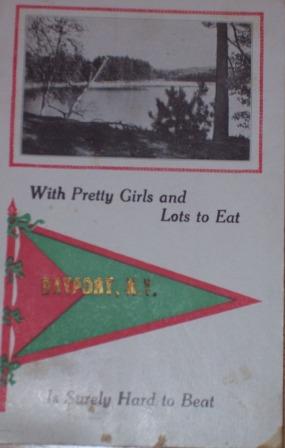
This one from Bayport, N.Y. in 1913 that you've only seen the front of so far ... it is another from Swede to George, where Swede signs off as "your loving wife." I have yet to tackle that!
.
And a couple others that I haven't posted yet....

Monday, March 19, 2007

Lives in Letters: Postcard from Brooklyn (2)

Here's a postcard I've been hanging on to for a while, written from a woman to her husband, just a year before the U.S. got into World War II.


Postcard
Half Moon Hotel
Brooklyn, NY
October 10, 1940

Addressed to

Mr. Charles J. K-
Hawthorne, NJ


Printed on front of card:

Half Moon Hotel – The Only New York City Hotel on the Atlantic

Message:


Hello Honey
Feeling pretty good today.
Hope it is the same with
you. Every thing seems O. K.
Here it is Thursday and
while you are attending
the Novena, I will register
for the coming election.
May the better man win.
Yes Charles! Will be looking
forward for Sunday
morning about 11AM we will
go to the Holy Name Society.
So long now. Yours, Love, Marie
Notes:

I started out thinking that Marie was on holiday at the Half Moon Hotel and sending a postcard back home to her husband. But the more I read this, the more I wonder -- how would she be registering for the election if she were away from home?

About that election, perhaps Marie was excited about a local race. Maybe her husband Charles was even a candidate.

But it's equally likely she was talking about the country's first 3rd term presidential election when Franklin Delano Roosevelt ran for re-election against Wendell Willkie. Roosevelt promised the American people (who were hugely isolationist even at this late date) that no American boy would fight in a foreign war. But at the same time, as the fall of Paris and other events in Europe had started to change the tide of American opinion, Roosevelt began to visibly shore up America's military to prove himself ready to engage if needed. He was an extremely popular candidate, and just a few weeks after this postcard was sent, he would win his third term as President by a large margin.

Go here to see a film of Roosevelt signing the declaration of war in 1941.

What else was going on in October, 1940?

Well, the Yankees lost the pennant in 1940, for the first time since Joe Dimaggio joined the team. But that's okay because Marie and Charles were more likely Dodgers fans, being from Brooklyn.

In mid-September the first peacetime draft in U.S. history was signed into law.

Further from home, beginning September 7, the Germans bombed London for 57 straight nights. Click the link for a pretty impressive photo.

And just two weeks before this postcard was sent, Germany, Italy and Japan signed the pact that formally allied them as the Axis Powers.

Meanwhile, back on the homefront....

For all you non-Catholics or pathetically bad Catholics (like myself), a Novena is 9-day series of prayers and/or church attendance for the purpose of asking for a special blessing or favor from God. The Holy Name Society was most likely a women's club within Marie's church.

Updated theory:

October 1940 was the end of the New York World's Fair (1939-1940). I notice the postmark on this card and the write-up of the hotel that is on the back both mention the World's Fair. So my new theory is that Marie was staying on Long Island for a holiday after all. Though how she got to register to vote, I don't know. Perhaps it was an exhibit at the fair.

Go here for all sorts of good info on the 1939-40 World's Fair.

Monday, March 05, 2007

Lives in Letters: Postcard from the Auto Roads

A quick old postcard for your amusement.


Postcard

Delaware Park,
Buffalo, N. Y.

July 17, 1918

Addressed to
Mr. & Mrs. H. H-
Patterson, N. J.


Noted below address: Furniture Mfg.
Arrived here this P. M.
after a wonderful trip
by Auto roads. Weather
& country beautiful. Hope
this finds you and Mrs. H-
in good health. Kindest
regards from the T-‘s
Notes:

Check out the clothing in the picture. It's very 1918.

I don't understand why there was an extra note scribbled at the bottom (under the address) that said "Furniture Mfg." Perhaps it was a business address.

There's not much to say about the message, but I loved the reference to the "Auto roads." I can almost imagine a time long ago, when an automobile trip would be a quiet and wonderful experience that allowed you to see the beautiful country. These days, you pretty much only see the SUV in front of you and the big rigs on either side.

Update: In the comments, a link with some very cool info on Delaware Park. I didn't realize it was an Olmsted creation. Thanks dshep!

Monday, February 19, 2007

Lives in Letters: Postcard - Toot

"In every city, on every street, there are forgotten buildings...."


Postcard

Cities Service Building
New York’s Third Highest Skyscraper

New York, NY
August 11, 1932

Addressed to Mr. J. E. L-
Lebanon, Pa.


Everything going O. K.
up here. The floors
will all be painted by
the time they get back.
Orders from War Dept.
to close Post Exchanges.
Ft. Hamilton and West Point
are already closed. Uncertain
how it will effect this place.
Received your mail.
Toot.
Notes:

Is it from someone nicknamed Toot, or is Toot a way of signing off, like "Tootles?"

The Cities Services building is located in the Wall Street area, and was so-named for the petroleum company that made its home there in 1932. It is now the AIG building. Here's a bit more info (see # 15). And then there's this interesting article about the skyscrapers of the age ("In every city, on every street, there are forgotten buildings...") including this building. The most interesting part of the article? Near the end, when the author says:
Though now dwarfed by young upstarts, such as the World Trade center, these office buildings have lost little of their original beauty and interest.
The article was written in July, 2001.

Post Exchange (PX) or Base Exchange was the name for the discount store located on a military base. Here's a bit of history on that.

My big questions:

What base was the postcard-sender writing from? My best guess is either Governor's Island off the tip of Manhattan, or maybe Fort Schuyler in the Bronx.

Why were they closing the post exchanges? Most likely because it was peace-time and the US had a very small army. Not to mention the fact that we were in the middle of the Depression, so the government could not afford to subsidize the PX's.

Who were "they" and why were they having the floors painted? I have no idea.

Monday, February 12, 2007

Lives in Letters: Valentines Postcard

Oh, this is too wonderful. A postcard from 1907, with a secret message hidden inside the red suede mitten.
I was barely able to open the note without destroying it, but I got it.

Postcard
Message Cupid Never Sent
Lynxville, Wisconsin
December 28, 1907

Addressed to
Mr. Clyde H
Platteville, Wis.


Written on secret note:

Hello Cupid. How's this for a card?
You see we even have Cupids in L-.
We girls are having fine times; were
out to the Xmas trees last eve and Mon
night a crowd of us are going to Seneca
to a dance, tho of course I shall not
dance. How's Fritz making it. I bet he
don't care half as much about the
restaurant now. Ha! Ha! Well my
time is limited so Ta Ta Ellie Olsen the end.
Edna

Lives in Letters: Postcard about Papa

I'm running late today, but wanted to share this postcard quickly.

Postcard
Hooker’s Trout Pond,
Mt. Pocono, Pa.
Tobyhanna, PA
August 6, 1908

Addressed to
Mrs. Mary S
Haledon, N.J.


Dear Grandma,
We like it
here very much.
Papa is going home
to-night. Says he’s
gained 6 lbs. in
6 days and is
coming up again.
He’s very sorry he
has to go home.
Hope you are well.
Lots of love from all,
Mabel

Notes:

I love the name Mabel. It's such a wonderfully old-fashioned name that I think deserves a comeback.

I also love that she calls her dad "Papa."
.
This postcard was from the early days of summers in the Poconos. From a time when the mother would take the kids away from the hot city for the summer, and the father would come visit for a week, or even just weekends. Like "Seven Year Itch" but 50 years earlier.
.
I did some very quick research on Mt. Pocono, and found out that I picked the perfect Valentine-themed postcard. After all, it was in the area of Mt. Pocono that a very important invention came about:
I love that!

Monday, February 05, 2007

Lives in Letters: Postcard of Alarm

Sometimes I come across a postcard like this one.

Postcard
Clinton Square
Syracuse, NY
February 20, 1913
.
.
Addressed to
Miss Laura J-
Clifton Springs, NJ

Scribbled at top:

Mother
is ill.
.
Message:

Dear Laura
Where have you
gone to – Are you
ill or what has
happened to you –
Ada N

Notes:
.
Isn't it interesting to see this kind of message in writing? Today, if we were worried about not hearing from someone for a while, and concerned they might be hurt or sick, we'd pick up the phone. But in 1913, they sent postcards.
.
And then they waited.
.
Whose mother was ill? Ada included her last initial, so I doubt Ada and Laura were sisters.
.
That picture was Clinton Square in Syracuse in 1913. Today you can see Clinton Square in real time via the clintoncam. Or you can take the virtual tour and see some better shots of how the square has stayed the same and how it has been updated.
.
From penny-postcards to virtual tours? One thing's for sure, the times they have a-changed.

Monday, January 29, 2007

Lives in Letters: Audience with the Pope

Here's another postcard sent to my great-great Aunt Jean, but this one about 40 years later than the one I showed last week. Aunt Jean was still a live-in nanny, and was spending the summer with her "family" up in Bar Harbor, Maine. Her friends and coworkers, meanwhile, were travelling to slightly more exotic places.

Postcard
Guardia Suizzera
Citta del Vaticano
August, 1954


Addressed to
Miss Jean F-
Porcupine House
Bar Harbor, Maine, U.S.A


Dear Jeannie,
This is the Swiss
guard at St. Peters.
We had a private
audience with
the Pope this
morning which
was very exciting.
I'm having a
terrific time and
am going to
Capri tomorrow.
Give my best to Evaline
+ the cook.
Love
Loy

Notes:

I've seen the Swiss Guard at St. Peter's a few times, and they're always dressed like this. Here are some things you might not know about the Swiss Guard, courtesy of wikipedia.
  • They are mercenaries.
  • In 1927, the Swiss outlawed the use of Swiss soldiers in any foreign armies, however the Papal Swiss Guard was left as the exception.
  • Members of the Swiss Guard must be Catholic, single, age 19 to 30 upon joining, and at least 5 ft 9. They serve from 2 to 25 years.
  • 2006 was the 500th anniversary of the Swiss Guard.
  • The uniform of the Swiss Guard was designed in 1914. The colors represent a blending of the family colors of Pope Julius II and Pope Leo X.
  • They are not to be messed with. They may look cute and even a bit silly, but they are well trained soldiers who will take you down if need be.
  • When sworn in, the Swiss Guard take the following oath (translated from German):
I swear to faithfully, honestly and honorably serve the reigning Pope [name of Pope] and his legitimate successors, and to dedicate myself to them with all my strength, ready to sacrifice, should it become necessary, even my own life for them. I likewise assume this promise toward the members of the Sacred College of Cardinals during the period of the Sede Vacante of the Apostolic See. Furthermore, I pledge to the Commandant and to my other superiors respect, fidelity, and obedience. I swear to abide by all the requirements attendant to the dignity of my rank.
I don't know much about getting a private audience with the Pope, aka the Bishop of Rome, aka the Vicar of Christ, aka the Supreme Pontiff, but never never never never aka Peter. Popes are not allowed to choose the name Peter. I do know that.

Did you know that the youngest man to become Pope was only 18 years old? That the shortest reign as Pope was less than 2 weeks?

Did you know the Vatican has a website? Oh yeah, Pope Benedict XVI waving at you from a site that looks like it's straight out of a Dan Brown book. Now I ask you, if you saw a link on that site called "Vatican Secret Archives," wouldn't you just HAVE to click on it? But while it was loading, would you suddenly think, "Hey, how secret can these archives be? Hey... waitaminute!"

I wonder how Capri was. I wonder if Jean ever gave Loy's "best" to Evaline and the cook.

I think Aunt Jean traveled back to Scotland (where she was born) at one point, but I don't know that she did much travelling beside that. I wonder.

Monday, January 22, 2007

Lives in Letters: That Great Ship

My aunt sent me a bunch of postcards which arrived this weekend. Here's my favorite of them:

Postcard
Jesmond Dene Waterfall
Newcastle, England
April 23, 1912


Addressed to
Miss J. F-
c/o Mrs. Chas. G-
Hartford, Conn. U.S.A.

Message written on front:

Did you get my letter All safe. What a disaster befell that
great ship! Only topic of conversation.

Message on back:

Dear Jean, What do you
think of this one. I shall
send you coloured ones
also. This is a lovely
spot in summer time.
The weather here has
been lovely for three
days. Hope you are having
better weather also.
Chick

Notes:

This was addressed to my great-great Aunt Jean, who emigrated from Scotland in about 1906. She went to work as a live-in nanny, and continued at that job (with various employers) for a long, long time. This postcard was sent in the care of Mrs. G because Aunt Jean was in her employ at the time.
.
While a live-in nanny, my aunt was savvy enough to pick up investment tips from at least one boss. Go Aunt Jean!
.
Aunt Jean got a lot of postcards from all over the world. Some were from family (nephews), but most were from friends or coworkers.
.
This one had a few points of interest for me. First, I love that it was signed "Chick." I don't know why it continues to surprise me that people used great nicknames back in 1912, but I can't seem to get over it.
.
I also love the black-and-white photo on the front. I'm not sure how well you'll be able to make it out on the screen, but it is a beautiful scene of a waterfall and pool, and I hope that little part of the world looks the same today.
.
But the real reason I love this postcard is for the little message on the front. "All safe. What a disaster befell that great ship." In April of 1912, that can only mean the Titanic. Here is an American travelling in England, just days after the Titanic has gone down, with about 1,500 dead. The greatest peace-time tragedy to that point. How amazing to see such a big event in history through 9 words scribbled on the front of a postcard. "All safe. What a disaster befell that great ship."
.

Monday, January 15, 2007

Lives in Letters: Postcard from Central Maine

Just a quick postcard this week, but one I found intriguing.

Postcard
Norridgewock, Maine
August 19, 1935

...
.
Addressed to
Miss Lucy C-
St. Albans Maine

Wed. Morning-
Dear Miss C-
Montie is staying
with his brother Merle.
Was over last evening and
looked fine and said he
was feeling much better.
He stays with Merle so
as to have it quiet.
Said to tell you if noth-
ing happens and bad
spell doesn’t return, he
will get Merle to bring
him back a week from
Sunday, 30th of August.
Regards, Alice H.
Notes:
I'm not sure why I'm fascinated by postcards like this, but I suppose it's because of the stories I can invent around the brief messages.
.
For instance, I wonder who Miss Lucy C is. Who is she to Montie, that she'd be getting updates about where he is? And why wouldn't Montie send his own updates?
.
Who's Alice? Neither Lucy nor she seem like they could be related to Montie and Merle. Why would these two women exchange messages about the men?
.
I wonder what the bad spell could have been. Polio perhaps. Although plenty of other diseases were available to choose from at the time: influenza, malaria, tuberculosis....
.
Where is Norridgewock, Maine? About smack-dab in the middle of Maine, maybe a little southeast of the middle. Near Colby college (which by the way, opened its doors back when Maine was part of Massachusetts). It was the filming spot for the 2005 HBO movie Empire Falls. Here's a little history, circa 1886 of Norridgewock. Although this history was written 50 years before the postcard, from all signs on the web, the town did not change much in the interim.
.
St. Albans, where Miss Lucy C was receiving this postcard, was 30 miles away from Norridgewock. Again, from what I can find out, St. Albans was a similarly small and remote town.
.
For the life of me, I can't figure out who Alice and Lucy were to Montie. No matter how many times I read this, no story I come up with makes sense.

Monday, January 01, 2007

Lives in Letters: Postcard from a War Bride

Here's a bit of home-front war correspondence.

Postcard
Belmar Fishing Club
Belmar, NJ
July 22, 1943
.
.
Addressed to
Mr. and Mrs. Harold F-
Nutley, New Jersey

Belmar, N.J. July 22nd
Hi Folks! Eric is at
Monmouth for
OCS and we have a
cottage here thru
Aug. Eric looks
grand and the
course is now
four months. Eliz
shore is wonderful –
only wish Eric
were here all the
time. My folks are
here for a while.
Love, Dot
Notes:

OCS stands for Officer Candidates School. I can find both Army and Marines references that link to Belmar, New Jersey and OCS, but Monmouth was definitely the Army Signal Corps. The OCS for the Signal Corps at Fort Monmouth graduated over 21,000 candidates between 1941 and 1946 (thank you wikipedia). Here are a few details from one document describing the Army Signal Corps School:
Class 1 reported for the three-month training course on 3 July [1941]. Their curriculum included physical training, dismounted drill, military law, sanitation and first aid, military courtesy and customs, interior guard duty, defense against chemical attack, pistol marksmanship, supply, administration, mess management, map reading, signal communications, motor transportation, inspections, and training methods.

By 1943 the size of the OCS had significantly increased and the interval between classes had been cut to just two weeks. Courses in electricity and mathematics, as well as field exercises, had been added to the curriculum. The field exercises, simulating signal company support to an infantry division, afforded training in message center and messenger procedure, wire construction, and radio and wire
communication.

Dot mentions that the course Eric is taking is now 4 months. Reading further in the same document about Monmouth, I found that in 1943 a month was added to the course "to include an 18-day field exercise at Camp Misery, a sub-post of Fort Dix." Camp Misery. I doubt that was ironic.

Dot says Eric looks "grand." Does she mean in his uniform?

Not too bad a deal for Dot to spend a couple of months at the Jersey shore while her husband was in OCS. At least, she didn't seem to think so.

I think this letter was to her in-laws, Eric's parents. That seems to fit the tone and content.

Another find along my searches... read this short document about the Army Signal Corps OCS Association to learn just how easy it is to lose large chunks of history.

And another (also courtesy wikipedia) ... Julius Rosenberg (spouse to Ethel) was at Signal Corps Labs in Monmouth from 1940 to 1945. According to this citation, it was there he was first found out as a traitor.

Monday, December 25, 2006

Lives in Letters: Telegram from Santa

One December night, when I was just 6 or 7 years old, there was a knock on the front door. My mother or father went to answer it, and came back bearing the most important piece of mail I had received. It was my first ever -- and last (so far) -- Santagram.
Apparently, Santa Claus occasionally answers the letters of good little boys and girls. But being pressed for time, and in such a remote location, he does not rely on the U.S. Postal Service. Instead, he sends special telegrams, via Western Union, called Santagrams. I'm sure Western Union cuts the big guy a break, holly in their hearts and all that, because otherwise, how could Santa afford to send telegrams at all?

Here is my Santagram, from 1974 or 1975.


Dear Nancy:

I recieved your letter telling me that you have been a
good girl. I'll be coming to your house on Christmas Eve. So
get to bed early.

Love
Santa

P.S. I'll try to bring you some suprises.
A few notes:

Santa wasn't the best speller. In 8th grade, I'd pay for Santa's mistake, and be forced to write the word "received" 500 times so that I'd stop transposing the I and E. Luckily, I never had a problem with the word "surprises." Well, perhaps it wasn't Santa, but the guy at Western Union, who was probably transcribing so many telegram messages so fast for the Man in Red that he couldn't keep up with his editing.

Santa signed his message with Love. Isn't that sweet?

My brothers never got Santagrams, to my knowledge. Of course, they weren't nearly as good as I was.

Monday, December 18, 2006

Lives in Letters: Postcard from the Erie Canal

I love this postcard for the front and the back. Both are so wonderfully dated!

Postcard
Canajoharie
Palatine Bridge, NY
July 27, 1913
.
.
Addressed to
Mr. G.H. S-
Haledon, N.J.

Pre-printed on Front:
.
Lots doing at Canajoharie
How would you like to be me.
I certainly like this job
.
Message:

Been working hard
lately coming thru
the canal. Have
5 more days or so of
it. 72 locks. This is
some place. They
make Beechnut
Bacon here.
Swede
Notes:
.
On the front, take a look at the outfits in the picture. They seem even older than 1913 somehow. The pose is classic as well, as the man helps the lady with her shoe.
.
Also, this is another of the postcards where the location on the front (in this case Canajoharie) can vary. You don't see a lot of those anymore.
.
I love that this message is from Swede. It's such a perfectly wonderful name for a young guy working on a canal-boat in northern NY.
.
A canal boat? Sure. Palatine Bridge and Canajoharie are right along the Mohawk River, and the Erie Canal follows the Mohawk River. The Erie Canal was built in the 19th century to connect the Great Lakes to the Atlantic Ocean, and it was instrumental in putting many New York towns on the map along the way. This, from eriecanal.org:
The Erie Canal, begun in 1817, was a triumph of early engineering in the United States and one of the most ambitious construction projects of nineteenth-century America. It was longer by far than any other canal previously built in Europe or America, crossing rivers and valleys, cutting through deep rock, and passing through marshes and forests in its 363-mile course across New York State.
In 1913, it was still the "old" Erie Canal, before a major new construction left much of the original abandoned for a wider and more modern structure in 1918. You can see some photos of the original Erie Canal here.
.
Note that for Swede, it was going to take another 5 days to get through the canal. That's because they had to go from lock to lock, wait in line at each one, get raised up in the lock and passed to the next section. 72 times.
.
Okay, and what's this about Beech-nut bacon? Bacon??? Yes, you read correctly. The makers of the well-known baby foods got their start in Canajoharie, NY, making ham and bacon. Check out this entry in Wikipedia for more info. Or even better, read this bit of 1920's Beech-Nut propoganda. Here's a highlight:
The story of Beech-Nut is a typical romance of American business. It is the story of several country boys in Canajohari, NY, "all going in together," to make fine and wholesome foods.

They started with hams; then bacon. The idea of a bacon with distinctive flavor just
seemed to come up naturally and grow naturally....
I especially liked this bit:
It starts way back with the natural foods. Only the best may pass the Beech-Nut Portals of Vigilance.